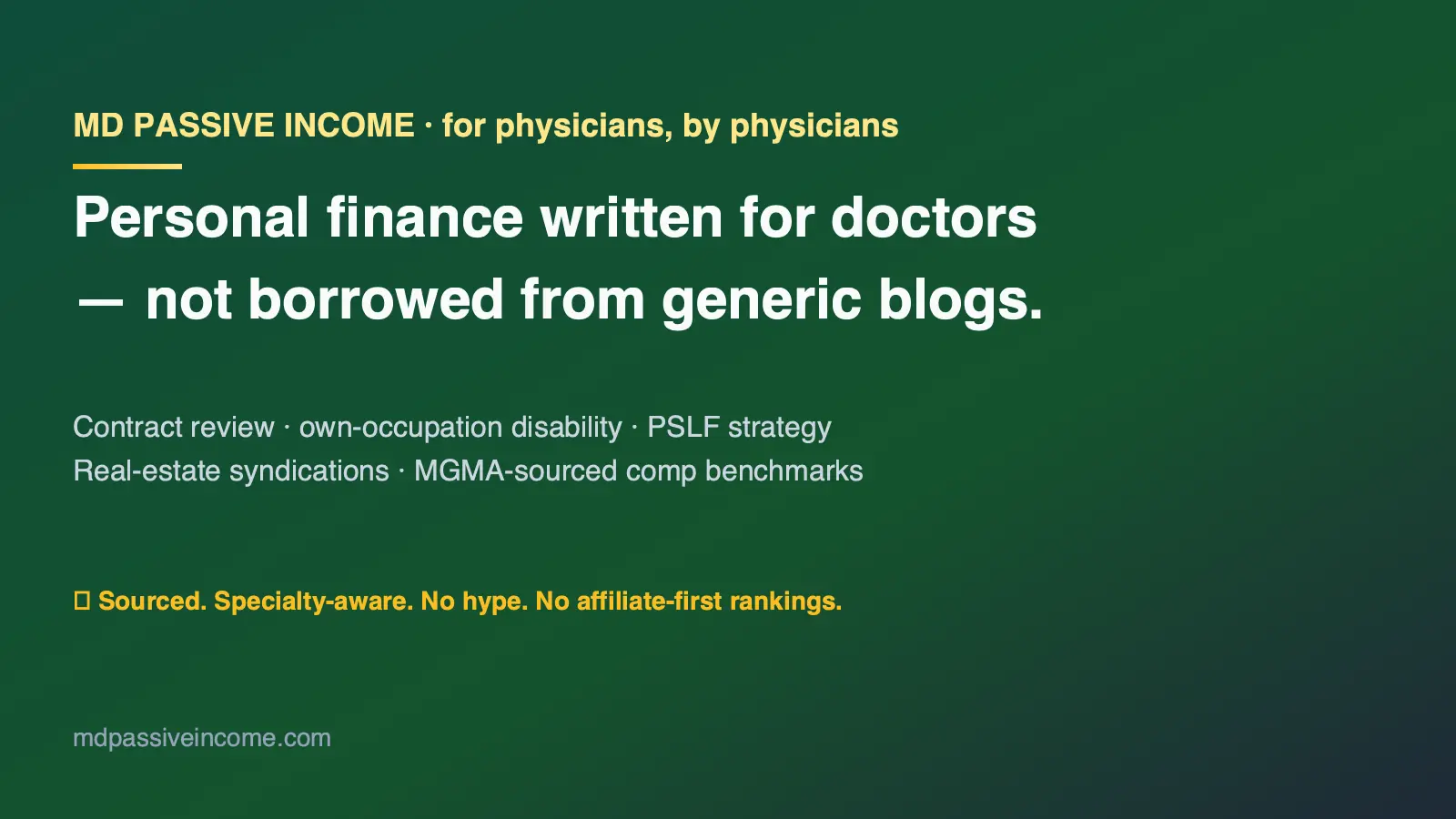
Contract review, signing-bonus benchmarks, PSLF strategy, own-occupation disability insurance, real-estate syndications, and the post-attending mistakes nobody warns you about — sourced, specialty-aware, and written for doctors with no time to waste.
Editor's note (April 2026): This site is being rewritten for our physician audience. New articles will follow the standard set by our Own-Occupation Disability Insurance piece — sourced, specialty-aware, no generic personal-finance hype. Older articles below predate the pivot and are being updated.
From signing your first attending contract to deciding what to do with a 5–10× income jump and $200k+ in student loans — the work each topic actually requires, and where to start.
The 8 clauses every first attending should negotiate — non-compete radius, RVU floor, malpractice tail, partnership track timing, restrictive covenant carve-outs.
Article in progress.
2026 MGMA + CompHealth median compensation by specialty, with signing-bonus ranges and what's negotiable in each market.
Article in progress.
What "true own-occupation" actually means, how to read a policy, and why specialty riders matter for surgeons, anesthesiologists, and procedural specialists.
SAVE plan in 2026, IDR recertification timing for residents, and the post-attending refi decision tree (federal forgiveness vs private rate).
Article in progress.
How accredited-investor physician syndications actually work — sponsor due diligence, K-1 tax mechanics, and the cash-on-cash math.
Article in progress.
Asset allocation when you finally have income, the 403(b)/457(b)/backdoor Roth stack, and the order of operations after residency.
Article in progress.
If you're just getting started, follow this roadmap to build your first passive income stream:
Written specifically for MDs and DOs — residents, fellows, and attendings. Educational, not financial advice.
The high-income physician tax playbook: the account-stacking order, the backdoor and mega-backdoor Roth, cash-balance plans, HSAs, real estate depreciation realities, and the S-corp question for 1099 income. Educational only; not tax advice.
Read Guide →The single highest-leverage tax move available to most physicians. How the strategy works, the pro-rata rule that wrecks it for most attendings, the exact click-path at Fidelity, Vanguard, and Schwab, and five real-world edge cases. Educational only; not tax advice.
Read Guide →A seven-clause checklist for new attendings reviewing their first employment contract — non-competes, tail coverage, RVU floors, partnership-track language, termination, restrictive covenants, and call. Educational only; not legal advice.
Read Guide →How cash balance plans work for solo-practice physicians, the age-based IRS contribution limits in 2026, how to layer with a solo 401(k), the actuarial/TPA costs to plan for, and when the math stops working.
Read Guide →A physician-specific guide to how doctor mortgage loans are structured, when they beat a conventional loan, and how to compare lenders without getting sold the wrong rate.
Read Guide →What own-occupation means for specialists, which carriers actually honor it, riders that matter (residual, future-increase, COLA), and how to size your benefit.
Read Guide →The decision tree for residents and early attendings choosing between Public Service Loan Forgiveness and private refinance. Specialty, employer type, and timeline matter more than the rate quoted.
Read Guide →Beyond physician-specific topics — methods our broader readership uses to build sustainable passive income
Comprehensive guide covering affiliate marketing, digital products, print-on-demand, stock photography, dividend investing, and more. Each method includes startup costs, income potential, difficulty level, and tools.
Read Full Guide →Step-by-step guide to launching your affiliate marketing business. Covers platform selection, niche research, content creation, and earning your first $100+ per month.
Read Full Guide →Complete guide to selling ebooks, courses, templates, printables, and software. Learn platforms, pricing strategies, and how to reach customers profitably.
Read Full Guide →Compare the best high-yield savings accounts earning 5%+ APY. Let your money work for you with minimal effort—true passive income.
Read Full Guide →Educational overview of dividend stocks for passive income. Understand dividend yields, growth stocks, and building a portfolio that pays you monthly.
Read Full Guide →The complete guide to building an email list from scratch and turning it into a passive income engine. Covers platforms, lead magnets, automated sequences, and monetization—including affiliate marketing, digital products, and paid newsletter tiers.
Read Full Guide →It depends on your method and effort. Affiliate marketing typically ranges from $500-$5,000/month after 6-12 months. Digital products can earn $1,000-$10,000/month. Dividend investing creates steady income based on your capital.
It depends. Affiliate marketing and content creation can start with just a domain and hosting ($15-50/month). Digital products need little investment. Dividend stocks require capital. Our guides break down each method's startup costs.
Affiliate marketing: 3-6 months. Digital products: 1-3 months. Email marketing: 2-4 months. High-yield savings: immediate. This assumes consistent effort and following proven strategies.
It requires upfront work. Once systems are built (content, email funnels, products), they generate income with minimal maintenance. Read our guides to understand the "active" work required upfront.
Start with affiliate marketing if you like writing/creating content. Digital products if you have expertise to package. Email marketing if you're building an audience. Our guides help you choose based on your skills.
Our guides are based on publicly available data, industry reports, and well-documented case studies. Income figures cited in articles reflect ranges reported across the industry, not guarantees. See disclaimers at the bottom of each article.
Choose one of our complete guides and start today.
View Start Here Guide Explore All Ideas